Ethnographic field research across donors, recipients, and blood banks exposed a predictable supply–demand gap — and a smart-inventory + camp-prediction service, now approved and in execution by the Nashik city council.
This was primarily service design and systems design — mapping a life-or-death, multi-stakeholder system end to end and designing an intervention at its highest-leverage point — grounded in ethnographic design research (shadowing, interviews, surveys) and delivered through UX / interaction design of a multi-role web portal and prediction tool. I led the design research and design end to end as the sole designer on a two-person team (the other a business-school student).
This was one of the challenges listed by TCS as part of the Smart Nashik initiative. Among various themes, I chose this challenge for the magnitude of the problem and its impact on society.
Purpose & scope. Each year more than 40 million units of blood are required across India — yet access to information about bloodstock availability and donation remains far from satisfactory. In a medical emergency, blood is a critical component, and a needy citizen should know where to get it, or how to access the required quantity quickly.
Reason: I wanted to design solutions in the health domain and understand this age-old challenge. Guides: Mr. Chakradhar Saswade, Dr. Aneesha Sharma.
Nashik is a city of around 1.4 million with only thirteen blood banks. Ideally one bank serves a million people, yet the banks aren't equipped — in infrastructure or instruments — to serve that purpose. The gap between supply and demand was structural, not random: emergencies turned into desperate searches while collected blood expired unused.
I started with secondary research — reports, statistics, journals, research papers — to understand the magnitude of the problem, then mapped the whole ecosystem and deliberately narrowed the focus from national to city level, because a life-or-death systems problem can only be fixed where you can actually observe its mechanics.

Over the next three weeks the team worked to understand the lives of recipients in hospitals, blood-bank in-charges, and donors. We interviewed in-charges from Jankalyan, Bytco, Arpan, Nashik, Jeevan, the Super-speciality hospital, and Civil hospital, who shared their daily schedules and challenges. We then shadowed donors at a blood-donation camp for observational research, and ran online surveys sent to around 100 residents of Nashik. Nurses described their actions and thoughts while we followed them through recipients' rooms (mainly the maternity ward). Back at the whiteboard, we mapped findings via empathy mapping and affinity mapping, surfacing gaps and opportunities across five lenses: process, people, technology, policy, and communication.


I divided stakeholders into core (Recipients, Donors, Blood bank — the targets of the solution), direct, and indirect.
The gap between demand and supply has grown consistently over the years. Mapping 2011 supply and demand revealed demand spiked in June and October (monsoons and the rise of dengue), while camp collection peaked in winter (Jan and Dec) and walk-in collection stayed low year-round (except May). Key insights from a six-week demand-vs-camp-collection comparison:
Primary research surfaced further blood-bank truths: inability to maintain supply at seasonal peaks; difficulty reducing wastage during oversupply; human error leading to fatalities; no proper channel to contact other banks/hospitals to transfer blood; competition to secure camp sites with no new camps added; and no timely payment from hospitals with no point of contact.

From ~100 surveyed/interviewed donors, the barriers to a potentially life-saving donation were: general lack of knowledge about the process and demand; no prior information on upcoming camps; fear of rejection at the campsite; inability to track donation dates; distance and time constraints; and no post-donation follow-up.
When a recipient needs blood, families approach a bank and often end up paying a high price or finding replacement donors. Gaps: reliance on hospitals to find bags; no unified source on blood availability; no real-time donor tracking; lack of awareness in the issuing process; and difficulty finding donors, leading to high anxiety.
I analysed existing market solutions to understand their benefits and failures. Even good services failed in some way — because each catered to only one section of the chain.

Rather than a point solution, I proposed a holistic service — an enterprise product owned by the blood bank and connected to both recipients and donors — with three subsystems:
We conceptualized and designed all three subsystems and gathered user feedback. The second subsystem (within the blood bank) clicked with stakeholders and showed the most promise in feasibility, impact, and business viability.

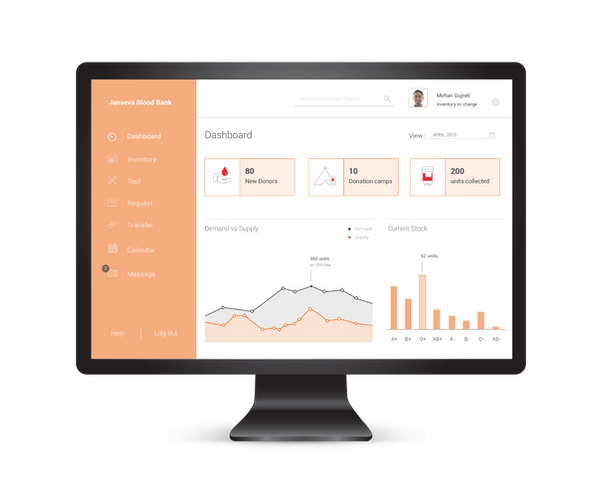
The system works on a prediction tool with defined input/output parameters. Features include:

The portal serves two key operators — the Inventory In-charge and the Camp Organizer — designed for the real operators rather than an idealized user.


Note: happy to share the other solutions (phase 1 and phase 3) that were explored but not implemented.