🔒

Protected case study

This Meta project is password-protected. Enter the password to view it.

← Back to portfolio
Design Research Product / AI Strategy Concept & Modality Design Generative Research Cross-market

Defining the North Star AI vision for WhatsApp Business

A two-market generative study that decided what AI should be for small businesses — establishing the strategic framework for modality, branding, and monetization architecture across a product serving millions.

My role
Lead Researcher & Design Strategist
Timeline
~3 months
Markets / sample
Mexico (8) + India (8) = 16 SMBs
Method
Generative IDIs · comparative concept testing
Tools
Figma · Stitch · Claude Code · NotebookLM
The problem

Many AI capabilities, no unified vision

WhatsApp Business was at an inflection point: multiple AI capabilities were being built in parallel (a business-focused agent, a general assistant, several interface modalities), but there was no unified vision for how they should come together for small-business users.

The stakes: with no shared direction, teams were building competing AI experiences for a product serving millions of businesses — risking a fragmented, confusing product and wasted investment.
What I set out to achieve

Define what AI should be for small businesses

From the outset the goal wasn't to ship a feature — it was to set a North Star: an evidence-based answer to what AI should be for SMBs on WhatsApp, plus the framework to get the team there. Concretely, I set out to answer four questions:

The challenges I faced

Designing for a vision, not a feature

How I resolved it · the approach

Comparative concept testing across modalities

Research & concept design

Execution & synthesis

Concept-testing stimuli

The three modalities, as live screens

To test the modality decisions with SMBs, I prototyped each modality across three core tasks — built in Stitch, with the microanimations running live (the pulsing field highlight, the floating tip card). Pick a task, then compare how each modality handles it.

JTBD
Guided UI · floating tips
Voice / avatar agent
Meta AI business agent
Guided UI · floating tips
Voice / avatar agent
Meta AI business agent
Guided UI · floating tips
Voice / avatar agent
Meta AI business agent

All of these prototypes were vibe-coded using Stitch.

Synthesis · Prioritization hierarchy

From jobs-to-be-done to a build order the team can act on

I synthesized the interviews into a prioritization hierarchy for the four core jobs — creating a business profile, setting up the catalog, inbox management, and creating ads & broadcast messaging — scoring each by importance and difficulty and segmenting by SMB type. It's not just a map of what matters; it's an actionable build order: the high-importance, high-difficulty jobs are where AI should land first — and the priority shifts depending on who the business owner is.
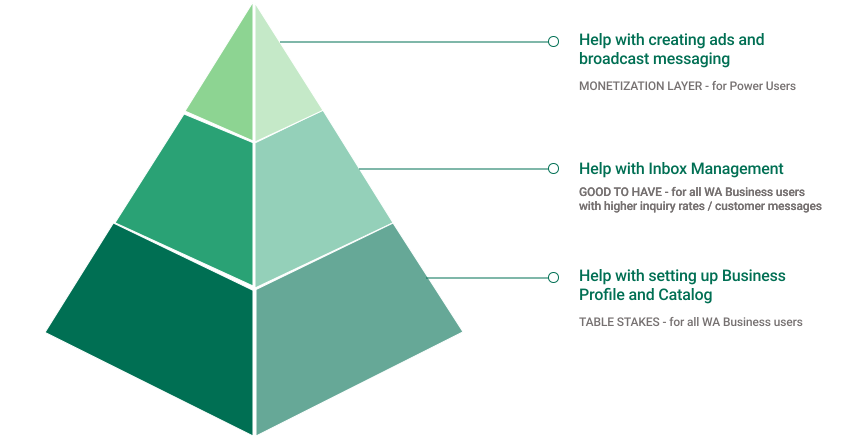
Prioritization hierarchy: four jobs-to-be-done scored by importance and difficulty and segmented by SMB type, indicating build order for the product team
Each job scored by importance × difficulty and segmented by SMB type — turning research into a prioritized, owner-specific build order for the product team.

Underneath that hierarchy is the raw distribution — how individual SMBs rated each job. The four jobs are plotted by importance and difficulty, and the size of each bubble denotes the number of SMBs who voted for that job — so the highest-leverage targets are the large bubbles sitting high on both axes.
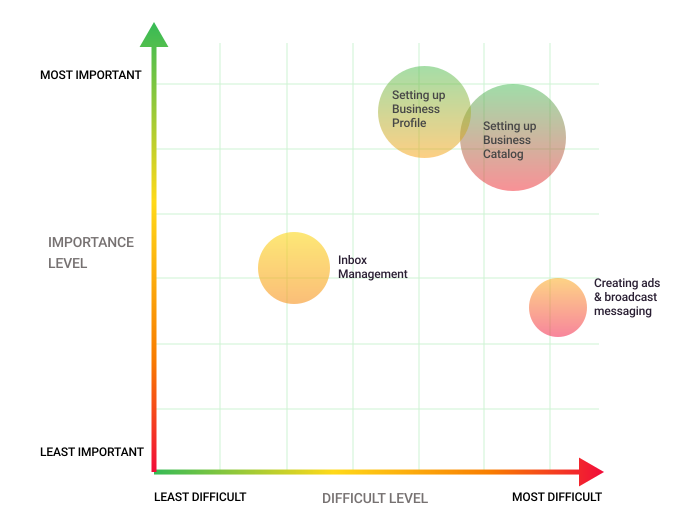
Bubble distribution: each of the four jobs-to-be-done plotted by importance and difficulty; the size of each bubble denotes the number of SMBs who voted for that job
Distribution of SMB ratings by importance × difficulty — the size of each bubble denotes the number of SMBs who voted for that JTBD.
Designing the human–AI interaction

The interaction decisions I shaped

Beyond findings, this study made concrete decisions about how people would interact with the AI:

Why it's design, not polish: task-dependent modality and the unified-assistant model were adopted as the monetizable architecture — the interaction decision and the business model were the same decision.
Framework · Modality × task complexity

Which modality wins for which task

The research pointed to a clear rule: modality should follow task complexity — with a smart default and the option to switch. Guided UI carries routine, structured setup; a chat assistant handles ongoing, conversational work; and a voice/avatar agent earns its place in the complex, novel "teaching moments." This framework maps the four core jobs to the modality that wins each.

Business Profile ROUTINE Catalog Setup ROUTINE Inbox Management ONGOING Ads & Broadcast NOVEL Guided UI floating tips ✓ Best fit Works Low fit Low fit Meta AI chat business agent Works ✓ Best fit ✓ Best fit Works Voice / avatar spoken agent Low fit Works Works ✓ Best fit LOWER COMPLEXITY HIGHER COMPLEXITY → VOICE EARNS ITS PLACE Best fit (smart default) Works — available to switch to Low fit / overkill
Best-fit modality per task as complexity rises — guided UI → chat assistant → voice/avatar. The default just leads; members can still switch modality, and the AI hand-holds rather than acting autonomously.
Design principles established

Principles the research turned into guidance

Task-dependent modality with smart defaults

Not a single-modality bet — AI form should follow task complexity, with sensible defaults and the ability to switch.

Business-first branding builds trust

Distinct naming anchored on outcomes ("talk to customers, get info, sell faster") resolves the agent-vs-assistant confusion and increases adoption.

One assistant, tiered customization

Default to pre-trained; offer custom options for power users — best UX and the clearest monetization path.

Hand-holding wins; autonomy that "closes the deal" doesn't

Keep humans in the loop for high-stakes moments; AI assists but doesn't close — this preserves trust.

Impact

The value it created — for users and the business

Value to users (SMBs)
  • A clearer AI experience: distinct, business-first branding that resolves the agent-vs-assistant confusion and lowers anxiety at the entry point.
  • The right modality for the task — guided setup for routine jobs, conversation for ongoing work, voice for complex moments — with the freedom to switch.
  • AI that hand-holds and keeps people in control rather than acting autonomously, which preserves trust.
Value to the business
  • Fed directly into the North Star AI vision and resolved competing internal bets — aligning PM, Design, Eng & Leadership on one direction.
  • Validated one unified assistant with tiered customization as both the best UX and the clearest monetization path.
  • Prioritized investment: profile + catalog setup identified as the highest-ROI AI bets (high importance, high difficulty).
How it added business value: the interaction decision and the business model became the same decision — a task-dependent, unified-assistant architecture that is at once the most usable experience and the most monetizable one, now guiding the AI roadmap for a product serving millions of businesses.
Reflection

What I learned

What worked: the two-tier recommendation structure made findings actionable across time horizons; cross-market convergence strengthened the recommendations; and framing every finding through business impact kept PM and leadership engaged.

What I'd do differently: add a quantitative validation phase to strengthen the "one assistant" recommendation; also test with experienced users (all participants were new to the agent), and coordinate earlier with adjacent research.

What I learned: how to design research that shapes long-term vision (not just evaluate features), the power of comparative concept testing, and how to translate qualitative insight into strategic frameworks leadership can act on.

My responsibilities & artifacts

What I owned

Responsibilities
  • Designed the study around two strategic levels
  • Designed concept stimuli for three AI modalities
  • Built the JTBD prioritization across the SMB workflow
  • Ran comparative concept testing across two markets
  • Synthesized findings into a North Star framework & design principles
  • Aligned PM, Design, Engineering & Leadership on direction
Artifacts delivered
  • Comparative concept-test research design
  • Three-modality concept stimuli
  • Jobs-to-be-done map / prioritization hierarchy
  • North Star vision input + two-tier recommendations
  • Design principles set
  • Findings share-out to cross-functional stakeholders
What kind of design this was

Design research that set product & design direction

This was generative design research and product strategy — the upstream design work that decides what a product should become before any screen is finalized. As design researcher and strategist, I designed the concept stimuli for three AI modalities, mapped jobs-to-be-done across the SMB workflow, ran a comparative evaluation, and synthesized the findings into a North Star framework and a set of design principles that now guide modality, branding, and monetization decisions for WhatsApp Business AI.

← All work Next: AI Monetization concept testing →